
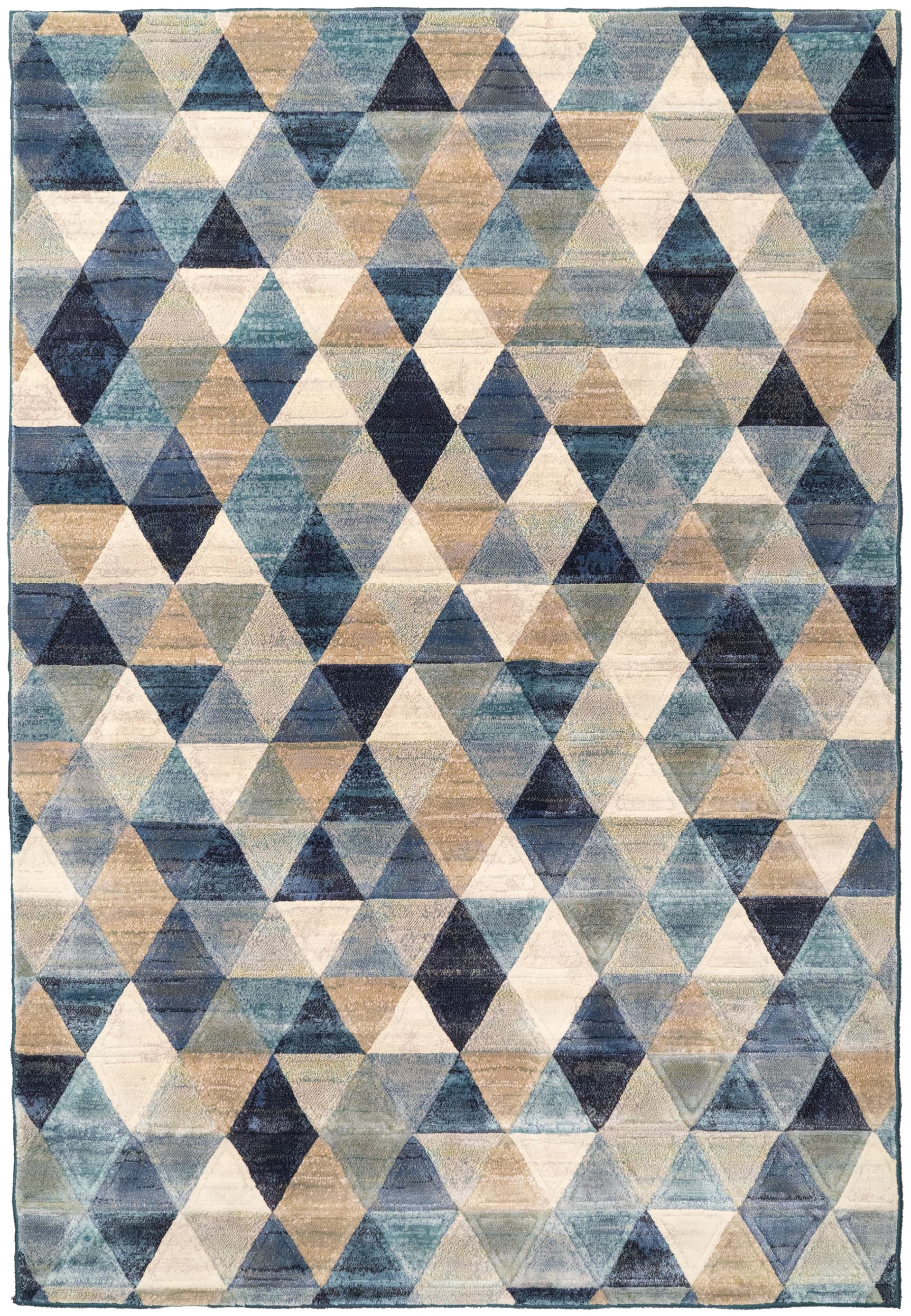
In short: Living room: front legs of every seat on the rug, 8x10 for most rooms and 9x12 for large ones. Dining rooms want 24 inches of rug past the table on every side, so a six-seat table needs a 9x12. Bedrooms take an 8x10 under a queen and a 9x12 under a king. Between two sizes, buy the larger.
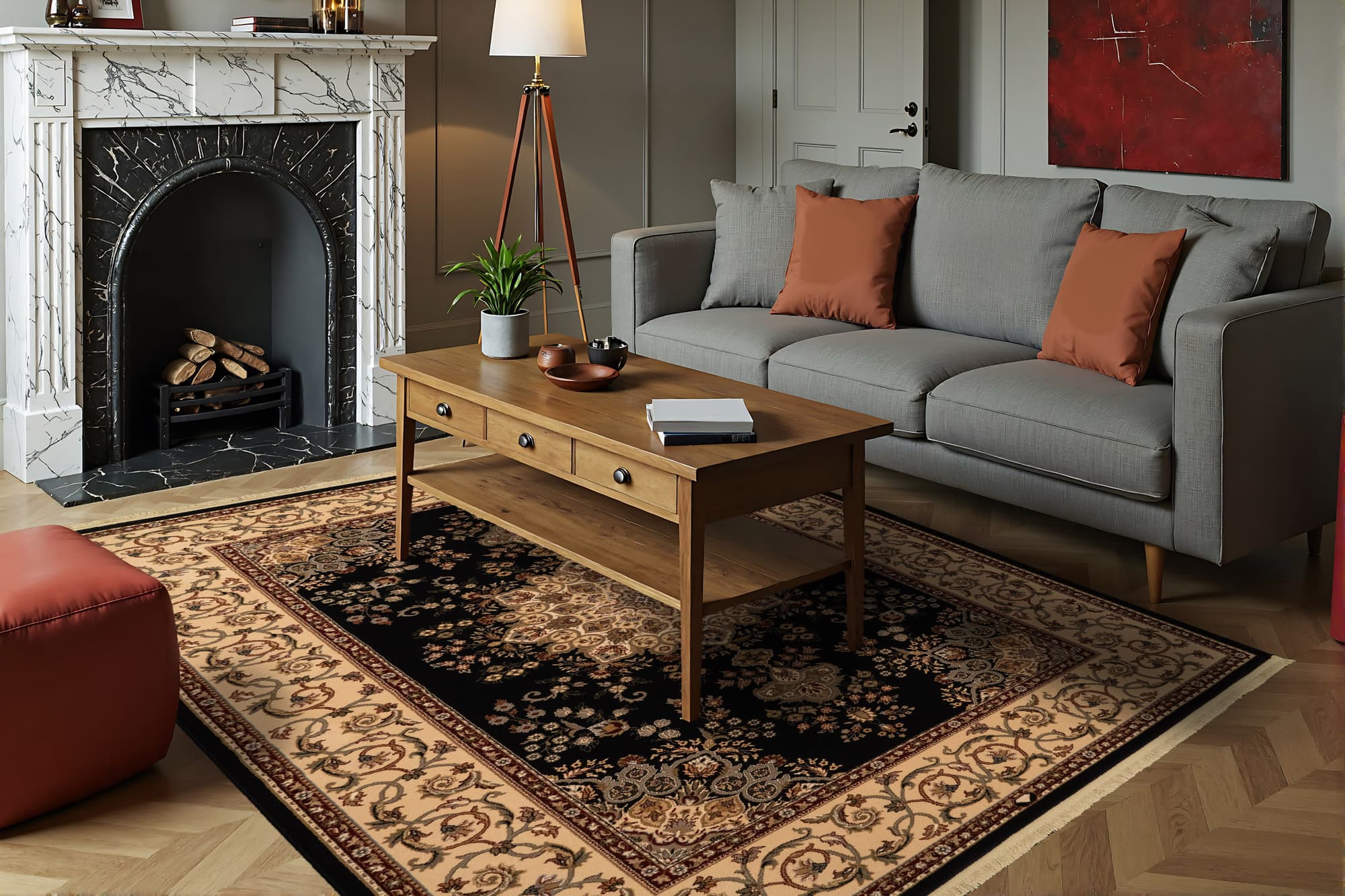
Hyacinth Brilliant Black, new zealand wool woven in Belgium.
Ask us which size to buy and the answer is almost always the bigger one. A rug that is too small floats in the middle of the floor and the furniture around it looks lost. Below is the rule for each room, the size to buy for common furniture, and a way to test it on your floor before you order.
Living room
The rule: the front legs of every seat sit on the rug. Sofa, loveseat, armchairs, all of them. The coffee table sits fully on it. The back legs can hang off.
- Three-seat sofa with two armchairs: an 8x10 in most rooms.
- Large room, a sectional, or seating spread wide around a fireplace: a 9x12.
Leave about 18 inches of bare floor between rug and wall in an average room, and no less than 8 in a small one. If your math lands between two sizes, take the larger.
Living rooms take feet, paws and spills, so a dense low-pile polypropylene like Ancient Garden makes sense, and it has the widest size range in the store. Browse every size on our living room rugs page.
Dining room
The rule: the table, plus 24 inches on every side. That keeps a chair on the rug when someone pushes back from the table.
Measure the table top, then add 48 inches to the length and 48 to the width. Say your table is 72 inches long and 40 wide: that becomes 120 by 88, and the smallest rug that covers it is a 9x12. A six-seat table almost always lands there. A four-seat table usually fits an 8x10.
Food and drink hit this floor, so pick polypropylene or polyester and skip viscose. Our dining room rugs page is filtered to sizes that work under a table.
Bedroom
The rule: the rug goes under the bottom two thirds of the bed and extends past both sides and the foot. The nightstands stay on bare floor. You want rug where your feet land when you get up, not under the headboard.
- Queen bed: an 8x10, turned so the long side runs across the bed.
- King bed: a 9x12, turned the same way.
- Tight room or tight budget: a 5x8 across the foot of the bed, or a runner along each side.
Bedrooms are the one room where softer fibers make sense: bare feet, low traffic, no food. A viscose line like Lara or the New Zealand wool of Brilliant feels good in the morning, but both are delicate, so keep them away from the door. Our rug materials guide covers which fiber belongs where; sizes are on the bedroom rugs page.
Hallway and entryway
Hallways call for runners. Measure the hallway width and subtract 8 inches, which leaves about 4 inches of floor on each side so the runner looks framed rather than wall to wall. Stop a few inches short of the doorway at each end. Standard runner rugs cover most halls; for an unusually long one, call 1-888-RUG-3396 and ask about roll runners cut to length.
Entryways are about the door. Open it all the way and note the arc it sweeps. The rug should sit inside that arc with nothing for the door to catch, or start beyond it. That means a 2x3 or 3x5 for a small entry and a 4x6 for a wider one, low pile only, since a thick rug jams the door. Choose heat-set polypropylene here; it resists stains and cleans with mild soap and water. See our entryway rugs, and read best rugs for high-traffic areas for what holds up by the front door.
Kitchen
A kitchen rug lives in front of the sink, where a 2x3 or 2x4 is the right size, or along the run between sink and stove. In a galley kitchen, treat it like a hallway: a runner with about 4 inches of floor on each side, stopping short of the fridge door.
Low pile, polypropylene or polyester, nothing else, so grease and spills blot up off the surface. Our kitchen rugs page keeps to those fibers; viscose marks wherever water sits.
Nursery
Same rule as the living room: the front legs of the crib and the glider both sit on the rug, with open rug in the middle for floor time. In most nurseries that is a 5x8 or 6x9. In a large room, an 8x10 gives a toddler room to grow.
Spit-up, bottles and later crayons all land here, so choose a fiber that cleans with soap and water. The Kidz collection is polyester made for this room; our nursery rugs page has the rest.
Measure and tape it on the floor
Every rule above is easier to trust once you have seen the size on your floor. All it takes is painter's tape.
- Measure the furniture footprint: sofa and chairs, table top, or bed frame.
- Apply the room rule: front legs on, table plus 48 inches, or bottom two thirds of the bed.
- Round up to the nearest size we sell: 2x3, 2x4, 3x5, 4x6, 5x7, 5x8, 6x9, 7x10, 8x10, 8x11, 9x12, 10x14 or 12x15.
- Tape the rectangle on the floor at that size, corners at minimum.
- Live with it for a day. Open every door and pull the chairs out.
If a chair drops off the tape, a door catches on it, or it looks small from the doorway, go up a size. Add a rug pad an inch smaller than the rug on every side.
The mistakes we see most
Buying too small
This is the big one, and usually a cost decision. A 5x8 in front of a three-seat sofa leaves every chair on bare floor and the room looks like it has a bath mat in the middle. The jump to an 8x10 costs less than buying twice.
The floating rug
A rug with no furniture touching it has no anchor, so it reads as an accident rather than a choice. If the only thing on it is the coffee table, it is too small for the seating group. Get the front legs of the sofa onto it and the room snaps into place.
Ignoring the door swing
A rug that sits in a door swing gets scuffed and pushed out of square every day. Open every door while the tape is down, closets included. If one drags, move the rug or drop the pile height.
Frequently asked questions
What size rug should I buy for a three-seat sofa?
An 8x10 in most living rooms, placed so the front legs of the sofa and any chairs facing it sit on the rug, with the coffee table fully on it. In a large room, or with a sectional, move up to a 9x12 so no chair is left on bare floor.
Should a dining room rug go under the whole table?
Yes, and well past it. Add 24 inches on every side of the table top, which keeps the chair legs on the rug when someone pushes back. A six-seat table almost always needs a 9x12; a four-seat table usually fits an 8x10.
What size rug goes under a queen bed?
An 8x10, turned sideways under the bottom two thirds of the bed so it extends past both sides and the foot. A king takes a 9x12 the same way. In a small room, a 5x8 across the foot of the bed still puts rug underfoot on both sides.
How much bare floor should show around a rug?
About 18 inches between rug and wall in an average room, and no less than 8 inches in a small one. Hallway runners are the exception: leave about 4 inches on each side so the runner looks framed rather than wall to wall.
Is it better to buy a rug too big or too small?
Too big, as long as that band of floor still shows at the walls. A slightly large rug looks generous; a slightly small one looks like a mistake. Between two sizes, take the larger. If it does not work, you have 30 days to return it for a full refund with no restocking fee.
Front legs on, table plus 24 inches, bottom two thirds of the bed. Tape it out, take the larger size, and the rest is choosing a pattern. Start from the size you need, an 8x10, a 9x12 or a runner, or browse everything in the shop.
