

In short: A space-dyed rug is woven from yarn that was dyed in alternating tones along its length before it reached the loom. One strand carries several shades, so the finished pile reads as a soft mix of light and dark rather than one flat color. The effect looks natural, adds depth, and hides everyday marks better than a solid.
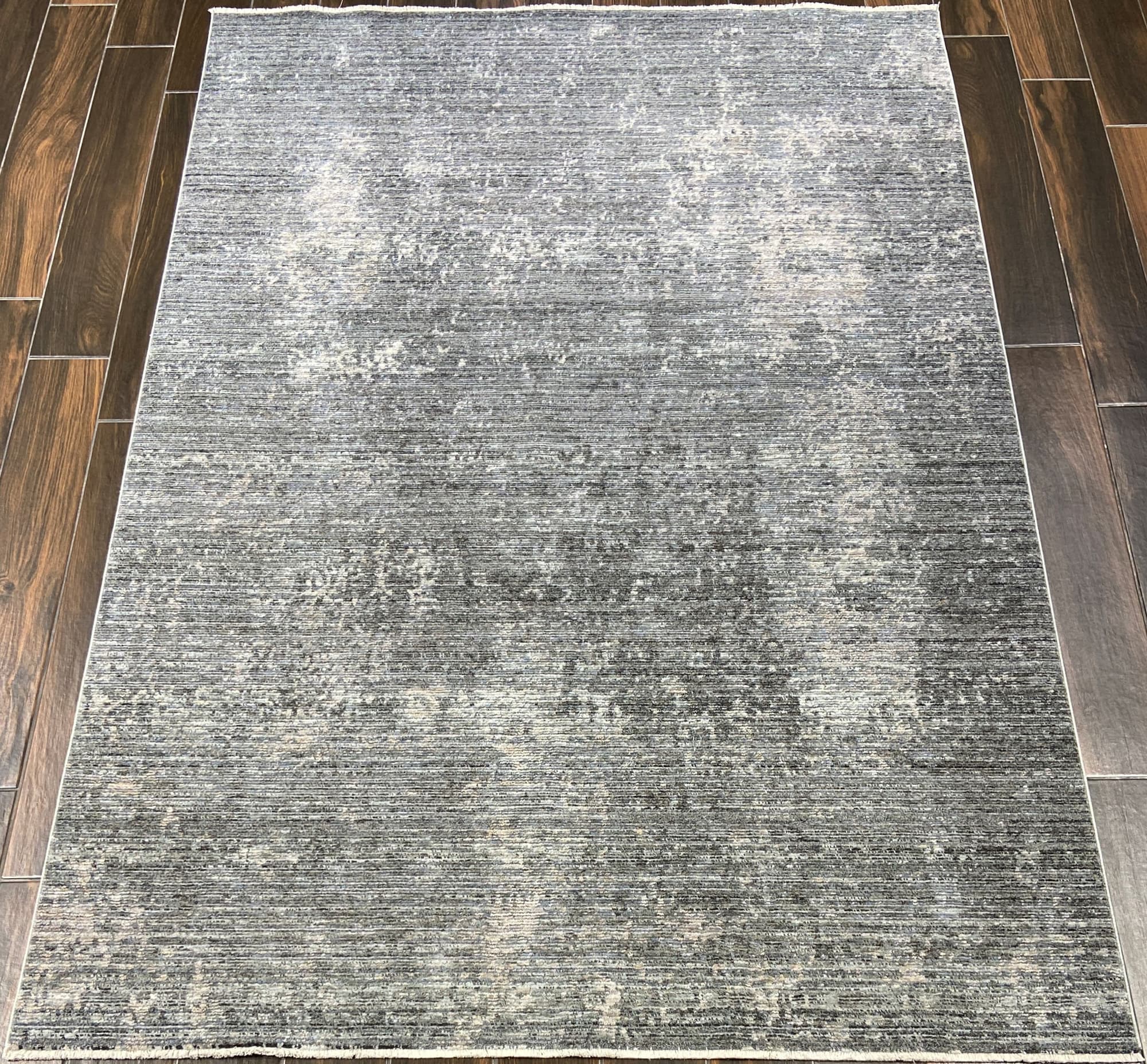
Mosaic Kyra Grey/Navy, space-dyed polyester woven in Turkey.
If you have ever noticed a grey rug that looks a little silver in one spot and a little charcoal in the next, you were probably looking at space-dyed yarn. It shows up across our Turkish polyester lines, and it is one of the most practical looks we sell. Here is what the term means and how to pick one for a room with real feet, paws and chair legs on it.
What space dyeing actually is
Standard yarn goes into a dye bath and comes out one even color from end to end. Space-dyed yarn is dyed in sections (the "spaces"), each a slightly different tone: a stretch of pale grey, then a mid grey, then a deeper shade, then back again. This happens before weaving, so every strand reaches the loom already carrying its own small palette.
On the loom, those sections land next to each other in no fixed order. Stand back and your eye blends them into one color with depth; get close and you see the shades side by side.
Three things worth knowing:
- It is not a print. The color is dyed through the yarn, not applied to the tips, so it does not wear off.
- The variation is random by design, so no two rugs place the light and dark in exactly the same spots.
- It is mostly done on polyester, sometimes polypropylene, because those fibers take dye evenly.
What it looks like on the floor
Think of a solid rug as a blank page. Every crumb, every paw print, every crushed spot where a chair sat shows against it. A space-dyed pile already has light and dark mixed through it, so small disturbances blend into variation that was there from day one.
In practice that means:
- Pile crush under a sofa leg or coffee table reads as a tone shift, not a bald patch.
- Fine dust and pet hair on a mid-tone rug mostly disappear between vacuums.
- A spot you blotted and got nearly all the way out is much harder to find afterwards.
It does not hide everything: a dark spill on a pale rug still shows, and no rug is stain-proof. But it stops the floor from announcing every small thing that happens on it.
Space-dyed vs heathered vs solid polyester
All three can be polyester in the same shade. The difference is how the color got there.
- Solid. One tone, end to end. Crisp, calm, and unforgiving.
- Heathered. Two or more differently colored fibers are spun together into one yarn, giving a fine, even fleck like a wool sweater. It reads as texture more than color variation.
- Space-dyed. One yarn, several shades in sequence. The variation comes in drifts and patches at a larger scale, so it reads as movement in the color itself.
A simple rule: heather looks like a texture, space-dyed looks like a color with depth. For hiding marks, space-dyed does it best, heather second, solid last.
Which rooms and styles it suits
Living rooms, family rooms, dens and bedrooms are the obvious homes for it. As a runner it also does well in hallways and at the front door, where tracked-in dust would show plainly on a solid.
Style-wise it leans modern, transitional and Scandinavian. It sits comfortably with linen sofas, oak or walnut, and black metal. Because the interest is in the tone rather than a drawn pattern, it lets the furniture do the talking. If you want a traditional medallion or an all-over Persian design, our Belgian Ancient Garden line covers that instead.
Sizing works the same as for any rug. In a living room, get the front legs of every seat on the rug (an 8x10 for most rooms, 9x12 for a large one), and when in doubt, take the larger size. The full rules are in our guide to choosing a rug size.
Collections that use it
Our space-dyed rugs come from the Turkish side of the range, power loomed by Dynamic Rugs. The three that show the effect most clearly are:
- Atlanta, tonal color in calm, contemporary designs.
- Milano, soft variation that reads as one warm color from across the room.
- Kyra, the most multi-tonal of the three, with light and dark drifting through the pile.
Several other Turkish polyester lines use the same yarn in places. If you are shopping by fiber rather than by name, the polyester area rugs page gathers them together, and rugs made in Turkey shows the whole Turkish group.
How to care for polyester
Polyester is one of the two fibers we are comfortable calling pet friendly (polypropylene is the other), and the care routine is short.
- Vacuum with the beater bar off. Suction alone is enough for a low, dense pile.
- Blot spills right away with a clean cloth. Never rub; it spreads the liquid.
- For anything that leaves a mark, use mild soap and warm water, then blot dry. No bleach, no solvents.
- Quarter turn the rug once or twice a year so wear and light are shared evenly.
- On hard floors, use a rug pad sized about an inch smaller than the rug on every side.
No rug is waterproof, so with a pet accident, speed matters more than the product. If your house has claws in it, choose a dense, low pile without loops. Our pet-friendly rugs page is filtered that way, and the rug materials guide explains where each fiber belongs.
Pairing it with furniture and wall colors
Treat a multi-tonal rug as a palette, not a single swatch. Every space-dyed rug has a lightest tone, a darkest tone, and a middle it reads as from across the room.
- Walls. Match the wall to the rug's lightest tone or go a step lighter. A grey rug with silver highlights suits warm white or greige walls; a blue rug with pale streaks suits a soft white.
- Large furniture. Keep the sofa or bed a solid close to the rug's middle tone, or a clean neutral (oatmeal, charcoal, tan leather).
- Accents. Pull the rug's darkest tone into cushions, a throw, or a lamp base.
- Wood and metal. Grey tones pair with oak, walnut and black metal. Blue tones pair with warm woods, brass and tan.
If you are starting from a color, our grey area rugs and blue area rugs pages both include space-dyed options alongside solids.
Frequently asked questions
Is a space-dyed rug the same as an ombre rug?
No. An ombre rug fades deliberately from one shade to another, usually light at one end and dark at the other. A space-dyed rug has no direction to it: the tones are scattered through the whole pile in no set order, so it reads as one color with depth from any angle.
Does the color fade or wash out?
The tones are dyed into the yarn before weaving, not printed onto the surface, so normal vacuuming and spot cleaning with mild soap and water will not lift them. Like any rug, it can lighten over years in direct, all-day sun, so give it a quarter turn once or twice a year. Avoid bleach and solvent cleaners, which can strip or shift the color on any dyed fiber.
Are space-dyed polyester rugs good for dogs and cats?
Yes. Polyester and polypropylene are the two fibers we call pet friendly. A low, dense space-dyed pile gives claws nothing to pull, hair vacuums up easily, and the tonal color hides paw prints and tracked-in dirt between cleanings. Blot accidents promptly with mild soap and warm water; no rug is stain-proof if a mess is left to sit. Wool and viscose are softer and more delicate, so we do not recommend them for homes with pets.
Will my rug look exactly like the photo?
The overall color and design will match. The exact placement of lighter and darker sections will not, because the yarn's tones land on the loom in no fixed order. That randomness is the point of the technique, and it is why two rugs from the same collection look related rather than identical. If a rug arrives in a different color than you expected, our 30-day return policy applies, with a full refund and no restocking fee.
Browse the full range of tonal color on our polyester area rugs page, or start from the shop and filter by color and size. Every order ships free in the contiguous US.
