

In short: Every rug we sell is machine-made on power looms in Belgium or Turkey by Dynamic Rugs. Belgian looms weave at a higher point count, mostly in heatset polypropylene, so traditional patterns hold fine detail. Turkish looms lead in polyester and space-dyed color. The product page lists the material and the country for every rug.
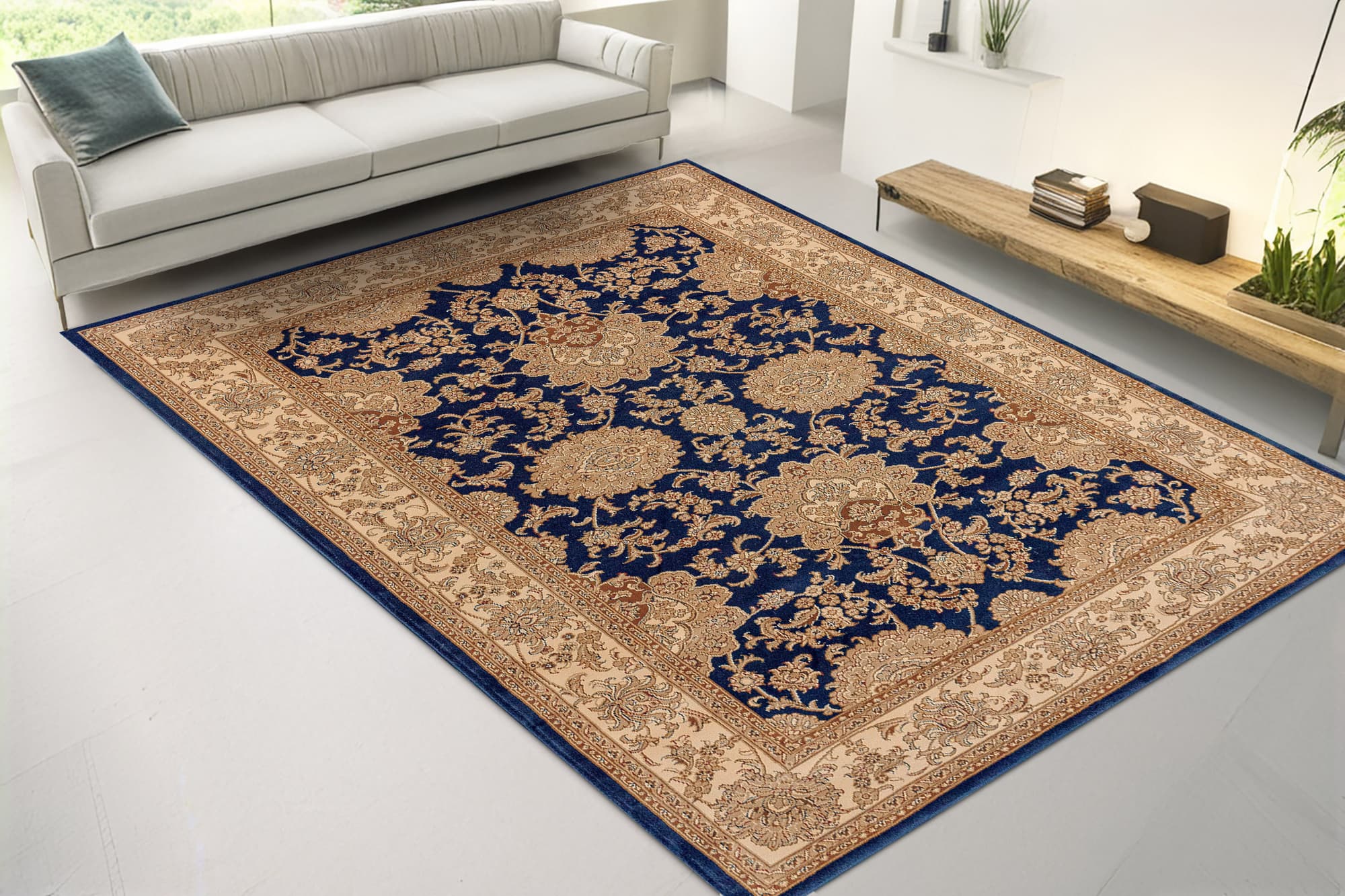
Acacia Legacy Navy, polypropylene woven in Turkey.
Every product page in our catalog tells you two things up front: what the rug is made of and where it was woven. The fiber is polypropylene, polyester, wool or viscose, and the country is Belgium or Turkey. This guide explains what each origin tends to mean for the rug that lands on your floor.
What "machine-made" means (and what it does not)
All of our rugs are power loomed. A power loom is a wide, computer-guided weaving machine: the pattern is loaded as a file, the loom feeds hundreds of spools of pre-dyed yarn, and it weaves pile and backing in one continuous pass. A design that would take months to knot by hand comes off the loom the same day.
That is the whole reason a detailed 8x10 costs hundreds of dollars instead of thousands: there is no hand labor tied up in each knot.
It is worth being clear about what machine-made is not. These rugs are not hand-knotted, and we never describe them that way. What you get instead is consistency: two rugs from the same run will match, the pile is even edge to edge, and the same pattern is offered in a dozen sizes. For a house with kids, a dog and a front door that opens fifty times a day, that is usually the right trade.
Belgium: the reference point for machine-made rugs
Belgium has been the center of European machine weaving for well over a century, and its looms are the ones the rest of the industry measures itself against. Two things stand out on a Belgian rug.
A higher point count
Point count is the number of yarn tufts in a given area of rug, roughly the way pixels work in a photo. Belgian looms weave at a higher point count than most, so a Persian medallion or a floral border keeps its fine lines and small motifs instead of softening into blocks of color. When the vines still look like vines up close, that is the point count at work.
Heatset polypropylene
Most of our Belgian collections are woven in heatset polypropylene. The color is locked into the fiber rather than printed on the surface, and the yarn is heat-treated so it holds a fuller pile. In daily life that means the color does not fade in a sunny room, most spills blot up off the surface with mild soap and warm water, and the dense low pile has no loops for a claw to catch. It sheds nothing. This is the fiber we point to first for entryways, living rooms and any home with pets; the whole range is at polypropylene area rugs.
The Belgian collections
- Ancient Garden: the flagship. Persian and traditional patterns, the widest size range in the catalog, in rectangles, runners, rounds and ovals. If you want a classic rug that stands up to a dog, start here, or read the Ancient Garden collection guide.
- Masai, Mehari and Couture: heatset polypropylene with the same easy care, each with its own design vocabulary.
- Brilliant: the exception in fiber. Brilliant is woven in New Zealand wool on the same Belgian looms. Wool is softer and more delicate than polypropylene, so keep it for bedrooms, formal living rooms and other calm spaces.
Browse everything from these looms at rugs woven in Belgium.
Turkey: where the patterns come from
Turkey is where many of these designs began. Oushak medallions, Anatolian borders, kilim geometry: the traditional patterns woven across the whole industry descend from Turkish and Persian weaving. Today that work happens on modern power looms, so a Turkish rug in our catalog gives you the heritage look at a machine-made price.
Polyester and space-dyed color
Where Belgium leads in polypropylene, Turkish mills are strongest in polyester. Polyester takes dye vividly and has a slightly silkier hand, so Turkish rugs tend to have the deepest blues, the richest reds and the softest pile at their price. Like polypropylene, it resists stains, does not shed and cleans with mild soap and warm water, so it earns the same pet-friendly label. See polyester area rugs.
Turkey is also home to most of our space-dyed polyester. The yarn is dyed in sections along its length, so a single strand carries several tones and the finished rug reads as softly variegated, closer to an aged rug than a flat print. We explain the process in what is a space-dyed rug.
The Turkish collections
- Atlanta and Kyra: space-dyed polyester with a multi-tonal, softly faded look.
- Milano, Yazd, Legacy, Juno and Timeless: the rest of the Turkish polyester and polypropylene range. Each product page lists the exact fiber.
- Wade: a wool and nylon blend, the wool for warmth, the nylon for strength. As with Brilliant, wool is softer and more delicate, so we do not suggest Wade for pet households or entryways.
Browse the full range at rugs woven in Turkey.
How to read the product page
Every rug on the site carries the same block of facts. Here is how to use it.
- Material. Polypropylene or polyester: any room, including entryways, kitchens and homes with pets. Wool: bedrooms, formal living rooms, spaces without paws. Viscose or viscose blend: bedrooms and formal rooms only, away from kitchens and entryways, and professional cleaning only. The long version of each fiber is in the rug materials guide.
- Country of origin. Belgium or Turkey. It tells you which loom and, usually, which fiber family you are looking at.
- Sizes. Rectangles run from 2x3 to 12x15, plus runners, rounds and ovals on many collections. Front legs of every seat on a living room rug, table plus 24 inches on every side in the dining room, the bottom two thirds of the bed in the bedroom. When you are between two sizes, take the larger.
Put material and origin together and the decision gets simple. A Belgian polypropylene 8x10 is the safe answer for a busy living room with a dog. A Turkish space-dyed polyester 5x8 gives you deep color in a bedroom with easy cleanup.
Frequently asked questions
Are Loom Genie rugs hand-knotted?
No. Every rug we sell is machine-made on power looms in Belgium or Turkey, and we say so on every product page because it is the honest answer. What you give up is the one-off quality of hand work. What you gain is an even pile, an exact match between sizes and colorways, and a fiber chosen for real households rather than for display.
Is a Belgian rug better than a Turkish rug?
Neither is better across the board. Belgian looms weave at a higher point count, mostly in heatset polypropylene, so they are the first choice for fine traditional patterns in a busy room. Turkish looms work mostly in polyester and space-dyed polyester, so they are the first choice for saturated color and a softer hand. Pick the fiber that suits the room first; either origin will give you a well-made rug.
Which origin is better for dogs and cats?
Origin matters less than fiber here. Polypropylene rugs from Belgium and polyester rugs from Turkey are both a good fit for pets: dense low pile with no loops to pull, no shedding, and accidents that blot up off the surface with mild soap and water. Brilliant and Wade are wool, which is softer and easier to mark, so we do not recommend either for a pet household. Everything that qualifies is on pet-friendly rugs.
Why is a machine-made rug so much cheaper than a hand-knotted one?
Labor. A hand-knotted rug is tied one knot at a time, and a detailed 8x10 can take a weaver months. A power loom weaves the same design in a single pass and repeats it exactly on the next rug, so the design cost is shared across the whole run. Heatset polypropylene and polyester also cost far less than hand-spun wool or silk. That is why a rug with a fine Persian pattern can cost hundreds instead of thousands.
How do I find out where a specific rug was made?
Look at the specifications on the product page. The country of origin and the material are listed for every rug we sell, next to the available sizes, and the tag on the back of the rug repeats the same information. If you would rather browse by origin, the Belgium and Turkey pages collect every rug from each country in one place.
Belgium gives you the detail and the easy-care polypropylene. Turkey gives you the color, the polyester and the patterns that started it all. Read the material and country lines first, match the fiber to the room, then browse the shop.
